Poticza
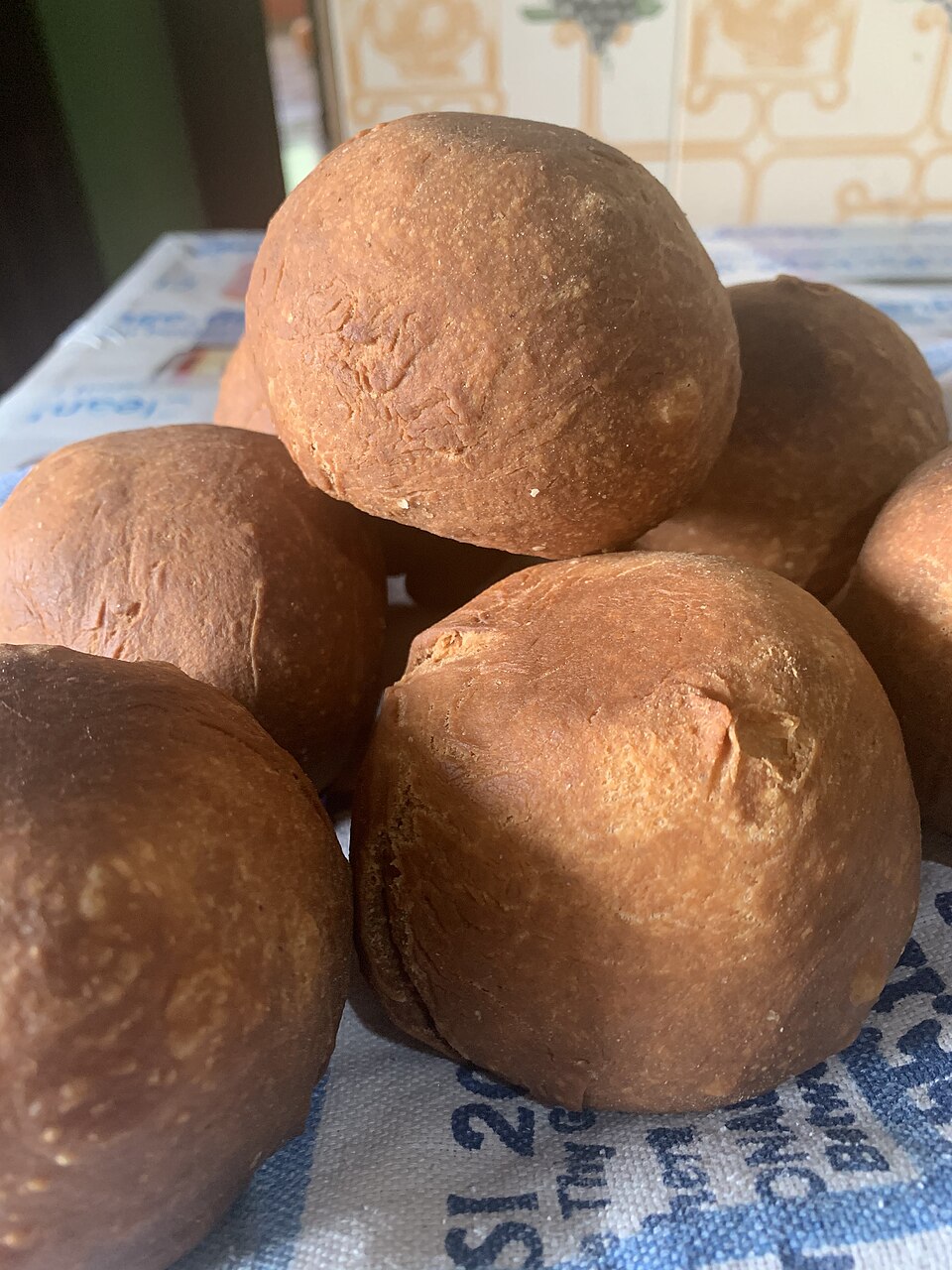
Poticza is a Slovenian nut roll, often seen around Christmas and Easter. This recipe, adapted from The King Arthur Flour Baker's Companion, makes two standard loaves of very rich bread.
- Prep
- 59 min
- Cook
- 2 hr 19 min
- Total
- 3 hr 18 min
- Servings
- As written in source
- Difficulty
- Advanced
Timings are approximate — worked out from the method, not measured in a test kitchen.
Ingredients
Quantities are retained as written by the source and do not scale automatically. Tap an ingredient to check it off as you go.
Cooking instructions
Special equipment
2 loaf pans (8.5 x 4.5 inches / 21.5 x 11.5 cm)
Special equipment
Rolling pin
Procedure
This process will take you straight through, from start to finish. If you'd like to divide the work across two days, the dough and/or the nut filling can be mixed the day before and stored in a covered bowl in the refrigerator until needed in the assembly process.
Procedure
Heat the milk and butter together in a microwave or in a small pan on the stovetop until the butter is melted and the milk is very warm, but not boiling. Set it aside to cool until it is warm but not uncomfortable to the touch.
Procedure
Combine ¼ cup sugar, 1 tsp salt, 3 cups flour, potato flour (optional), and yeast into a large mixing bowl. Stir the dry ingredients briefly to mix.
Procedure
Stir in the melted butter, warm milk, vanilla extract, and eggs. Using either the dough hook on an electric mixer, a big spoon, or your hands, mix and knead until the dough is smooth and uniform. This is a "slack" (wet) dough, so it will be quite sticky when you start mixing it. It should come together after a couple of minutes.
Procedure
Cover the kneaded dough and put it in a warm place to rise for about an hour. Alternatively, the dough can be brought to this point, placed in a bowl and covered with plastic wrap or a tightly fitting lid, and left in the refrigerator overnight.
Procedure
Stir together the chopped nuts, nut meal, the remaining 1 cup of sugar, the remaining ⅓ cup of flour, pinch of salt, cinnamon, and the remaining 3 eggs. The mixture will be a thick paste. However, if it's too thick, you won't be able to spread it. This is most likely to happen if you use very finely ground nuts or nut flours. In that case, add another egg. The nut filling can be made in advance, covered, and stored in the refrigerator overnight.
Procedure
Line the loaf pans with parchment baking paper, or grease them with butter.
Procedure
Put plastic wrap with a little flour on your work surface. It may be necessary to put down two overlapping pieces of plastic to make a surface that is large enough. Alternatively, for a more old-fashioned approach, flour a large, smooth, thin cotton cloth and use that to line your work surface. Because the dough will be cut after being rolled out and topped with the nut filling, a silicone baking sheet is not a good choice for this project; the blade of the sharp knife or cutter will permanently damage the silicone mat.
Procedure
Roll out the dough into a rectangle that measures 28x14 inches (72x36 cm). It will be quite thin, about ⅛ inch (3 mm) thick, when you're done. Patch any holes and thin spots.
Procedure
Make sure that the dough is not stuck to your work surface. If it is, loosen it, add a little more flour underneath, and re-check the dimensions with a ruler. If there is loose flour on the top of the dough when you have finished rolling it out, you can use a dry pastry brush to brush it off.
Procedure
Spread the nut filling evenly over the dough, from edge to edge. Any gap will change the swirled design that is seen when you cut the loaf after baking.
Procedure
The filling is thick enough that it can be cut with a dinner knife, especially if cold.
Procedure
Pieces of nut filling scattered across the dough.
Procedure
The nut paste has been partially spread.
Procedure
Evenly spread nut filling
Procedure
Because the filling is thick (and even stiffer when it is cold), this will take some time. It may help to break up or slice the filling into many small pieces with a dinner knife, and scatter those across the dough, so that you are spreading small bits of paste over small areas, instead of trying to spread one large lump across a large area. Work gently to avoid tearing the dough underneath.
Procedure
Cover the filling with plastic wrap or parchment paper, and run the rolling pin lightly over it again, without further stretching the dough or increasing the size. This helps flatten any thicker lumps of filling and help any bigger chopped nuts attach more securely to the dough.
Procedure
Use a pizza cutter, pastry wheel, or sharp knife to cut the dough in half, so that you have two matching squares.
Procedure
To get the four-swirl design, the dough has to be rolled from two opposite sides towards the middle. Start by folding one edge of the dough—about one inch (2 cm)—on top of the nut filling, and then continue folding or rolling that side towards the middle. Do not stretch the dough or roll it tightly. Traditionally, the log is formed by folding the first edge, lifting the floured cloth underneath it, and then letting the dough roll itself; you are trying to produce the same effect. After you have the first edge partially rolled, switch to the opposite side, and start rolling it towards the first one, so that they meet in the middle with two evenly matched scrolls. The dough has been rolled from opposite sides, until it nearly meets in the center.
Procedure
Take one end of the resulting rolled log and fold it to the center of the log. Repeat with the other end. Adjust it, overlapping the ends as necessary, so that the folded log fits inside the loaf pan. Place the folded log in the pan, seam side down.
Procedure
Repeat the process of rolling and folding with the other square of filling-covered dough.
Procedure
Place both pans in a warm place to rise for about 90 minutes or more. It should look a little puffy, but it won't double in size. Alternatively, the loaves can be covered tightly with plastic wrap and put in the refrigerator overnight. Bring the cold dough back to room temperature before baking.
Procedure
Preheat oven to 350 °F (180 °C / gas mark 4 / moderate oven).
Procedure
Bake both loaves at 350 °F (180 °C) for 30 minutes. Then, cover the tops with a loose "tent" of aluminum foil, to prevent the tops from browning too quickly.
Procedure
Bake for about another 15 minutes after tenting (a total of 45 minutes). If you have an instant-read thermometer, the internal temperature should be around 195 °F (90 °C).
Notes, tips, and variations
You can use any type of nut, or a mixture, as long as it can be chopped very fine without turning pasty like peanut butter. Walnuts, pecans, and almonds are good.
Notes, tips, and variations
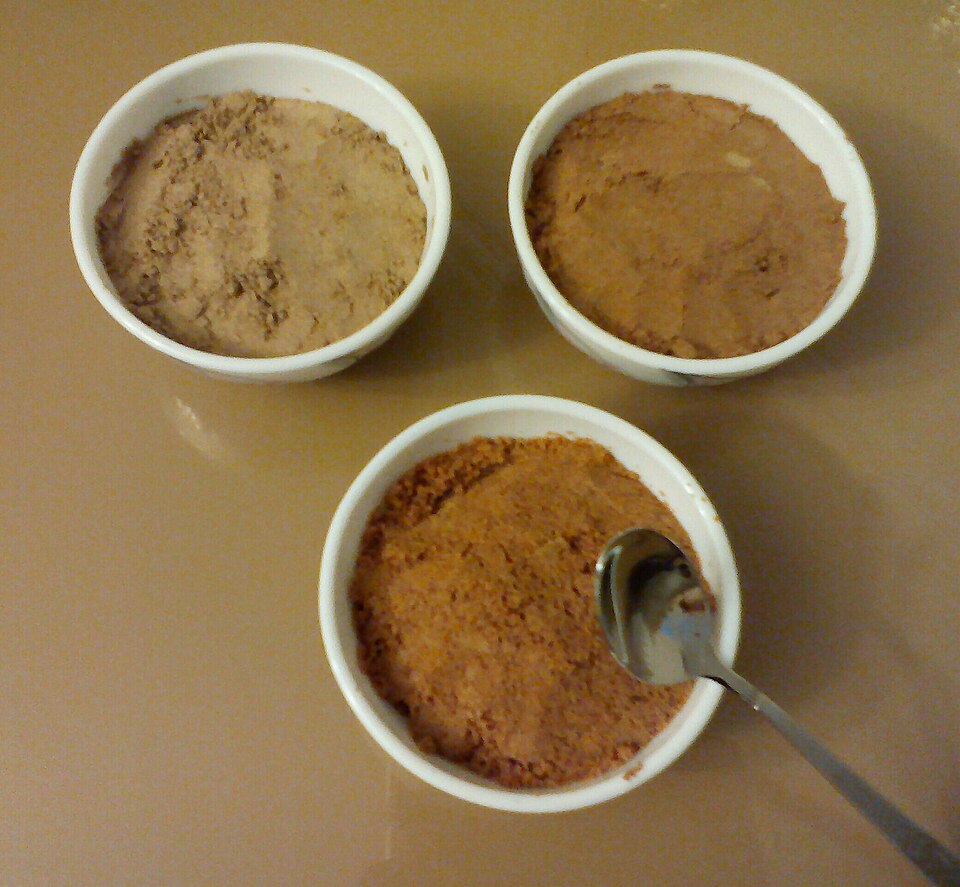
The nuts should be toasted in a moderately hot oven for 6–8 minutes first, and then chopped to very small pieces (⅛ inch or 3 mm). This can be done with a knife or mezzaluna, or by pulsing nuts in a food processor a few times. If you are measuring by volume, you want to have two cups of nuts after they've been chopped.
Notes, tips, and variations
Nut meal can be made by running nuts (raw, unsalted, with skins on) through a food processor until it resembles flour. If you are measuring by volume, remember that it takes more than 3 cups of whole nuts to make 3 cups of nut meal. Alternatively, some ready-made nut meals, such as almond meal or hazelnut meal, are readily available in grocery stores in many parts of the world.
Notes, tips, and variations
Potato flour makes the dough a little softer and easier to stretch thin. If you don't have potato flour, you can omit it. You can also substitute unflavored flakes of instant mashed potatoes, using half as much by weight (20–25 g), which is slightly more by volume.
Notes, tips, and variations
If you are using dried yeast, one packet measures a little less than a level tablespoon and weighs 7 g (¼ ounce). If you are using refrigerated "wet" (also called fresh, live or cake) yeast, then you should use about 20 g. In both cases, this is the normal amount of yeast for a typical bread recipe, so if you buy your yeast pre-measured in single-serving sizes, then use one serving.
Notes, tips, and variations
If vanilla extract is not the usual format in your country, then you can easily substitute your normal type. 1 tablespoon of vanilla extract is a relatively large amount of vanilla, equivalent to about three 9-gram packets of vanilla sugar. If you use a dried form of vanilla, stir it in with the dry ingredients instead of pouring it into the warmed milk, melted butter, and eggs.
Notes, tips, and variations
Up to 25% of the white granulated sugar in the filling can be replaced by sugar substitutes. However, as the primary source of calories in this recipe is the nuts, this will have a very minimal (less than 5%) effect on total calories consumed.
Notes, tips, and variations
This recipe was a special holiday food because it is relatively expensive to make. The biggest expense is the nuts (625 g or 1.3 pounds), which can easily cost US$10 or more. For a more economical version, reduce the nut filling by half, and add another egg (or even two) to the filling until it can be spread more thinly and easily. The loaves will be smaller, with thinner dark swirls. You can also choose less expensive nuts, such as using almonds or walnuts instead of pecans or pistachios.
Photo: WhatamIdoing · CC BY-SA 4.0 · https://creativecommons.org/licenses/by-sa/4.0 · Photo source and licence
Wikibooks contributors · CC BY-SA 4.0 · https://creativecommons.org/licenses/by-sa/4.0/ · Adapted; quantities retained as written. · Original source
Read it through first
Skim all 35 steps before you start — it is the difference between cooking and firefighting.
Scale it
Use the quantities listed in the original recipe. Adjust them manually if making a different batch size.
Storage
Cool completely, then keep in an airtight container in the fridge for up to three days.
Reheating
Reheat gently with a splash of water in a covered pan, rather than blasting it, so nothing dries out.
Nutrition information is not available for this recipe yet.
Reviews
No reviews yet. If you cook this, come back and tell everyone how it went.