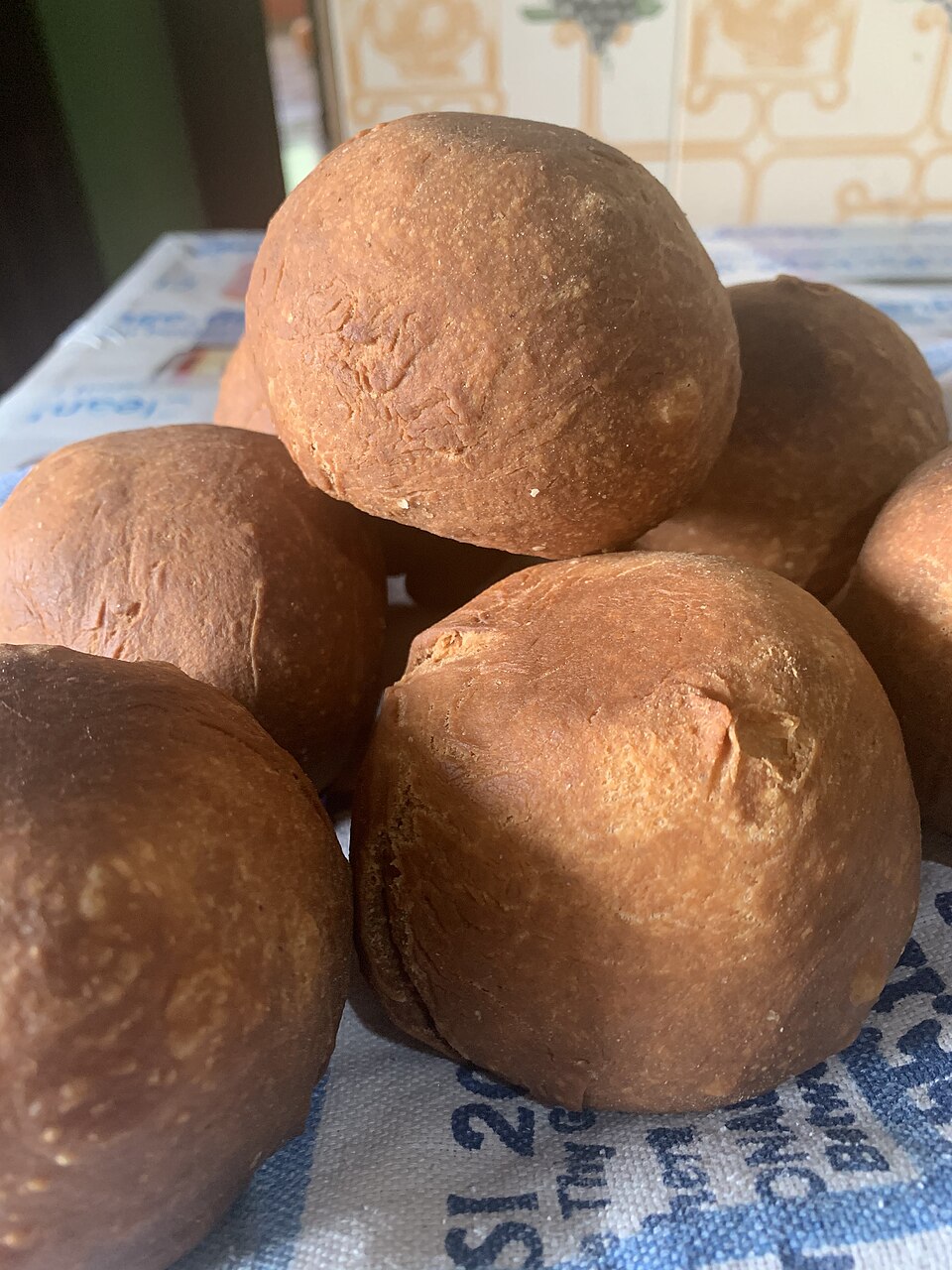
Plain Bagels
In large bowl, combine 1½ cups flour and yeast. Mix water, 3 tablespoons sugar and salt together, and add to the dry ingredients. Beat with a mixer for half a minute at a low…
- Prep
- 36 min
- Cook
- 1 hr 23 min
- Total
- 1 hr 59 min
- Servings
- As written in source
- Difficulty
- Advanced
Timings are approximate — worked out from the method, not measured in a test kitchen.
Ingredients
Quantities are retained as written by the source and do not scale automatically. Tap an ingredient to check it off as you go.
Cooking instructions
Procedure
In large bowl, combine 1½ cups flour and yeast. Mix water, 3 tablespoons sugar and salt together, and add to the dry ingredients. Beat with a mixer for half a minute at a low speed, scraping the sides of the bowl clean. Beat at a higher speed for 3 minutes. Then, by hand, mix in enough flour to make a moderately stiff dough.
Procedure
Turn out onto a lightly floured surface and knead until smooth and elastic (8–10 minutes). Cover, let rest for 15 minutes.
Procedure
Cut into 12 portions, shape into smooth balls. Poke a hole in the center with your finger, and gently enlarge the hole while working the bagel into a uniform shape. Cover, let rise 20 minutes.
Procedure
Meanwhile, start a gallon of water boiling. Put 1 tablespoon of sugar in it, mix it around a bit. Reduce to simmering.
Procedure
When the bagels are ready, put 4 or 5 bagels into the water, and cook 7 minutes, turning once. Drain them.
Procedure
Place on a greased baking sheet, and bake at 375°F (190°C) for 30–35 minutes. Remove from oven, eat hot or cold.
Notes, tips, and variations
Broiling option: For a glossier surface, place raised bagels on an ungreased baking sheet prior to boiling them. Broil them 5 inches from heat for 1–1½ minutes on each side. Then put them into the hot water to be boiled as above. Do not bake broiled bagels as long as non-broiled ones, 25 minutes should be long enough.
Conversion notes
↑ Volumetric values are approximate, and were adjusted to match procedure text. To conserve column space, tablespoons were abbreviated as "T", and teaspoons as "tsp". Conversions calculated from USDA National Nutrient Database data, as well as Google calculator (for the water weight).
Conversion notes
↑ All weights as grams were given in the original recipe text except for water, which was specified as 355 mL at (110 degrees F/45 degrees C). A density adjustment for 45°C was applied.
Conversion notes
↑ Bagels are typically made with high-gluten flour, and a low hydration of around 50-55%.
Conversion notes
↑ This excessive amount of yeast will result in a strong yeast flavor. To reduce this flavor, it is recommend to use no more than 0.775% instant dry yeast expressed as a baker's %, alternatively, 2.5% cake yeast (compressed) or 1.05% active dry yeast, although in all cases you can expect fermentation time to increase somewhat. Further reductions will result in less yeast flavor and longer bulk fermentation times.
Conversion notes
↑ According to Wikipedia, "Most bagel recipes call for the addition of a sweetener to the dough, often barley malt (syrup or crystals), honey, high fructose corn syrup, sugar...." Molasses is also sometimes used.
Conversion notes
↑ Important: this water for boiling section is based on water weight, instead of flour weight. This means it is not following the strict definition of baker's percentages, but instead a looser definition of analogous to baker's percentages. It will keep the ratio of sugar or alkaline to water correct should you need to use a different amount of water, or if you wish to increase or decrease the sugar or alkaline concentration.
Conversion notes
↑ According to Wikipedia an alkaline is often used instead, "boiling each bagel in water that may or may not contain additives such as lye, baking soda, barley malt syrup, or honey...."
Photo: Jeremy Keith · CC BY 2.0 · https://creativecommons.org/licenses/by/2.0 · Photo source and licence
Wikibooks contributors · CC BY-SA 4.0 · https://creativecommons.org/licenses/by-sa/4.0/ · Adapted; quantities retained as written. · Original source
Read it through first
Skim all 14 steps before you start — it is the difference between cooking and firefighting.
Scale it
Use the quantities listed in the original recipe. Adjust them manually if making a different batch size.
Storage
Cool completely, then keep in an airtight container in the fridge for up to three days.
Reheating
Reheat gently with a splash of water in a covered pan, rather than blasting it, so nothing dries out.
Nutrition information is not available for this recipe yet.
Reviews
No reviews yet. If you cook this, come back and tell everyone how it went.