Pasties
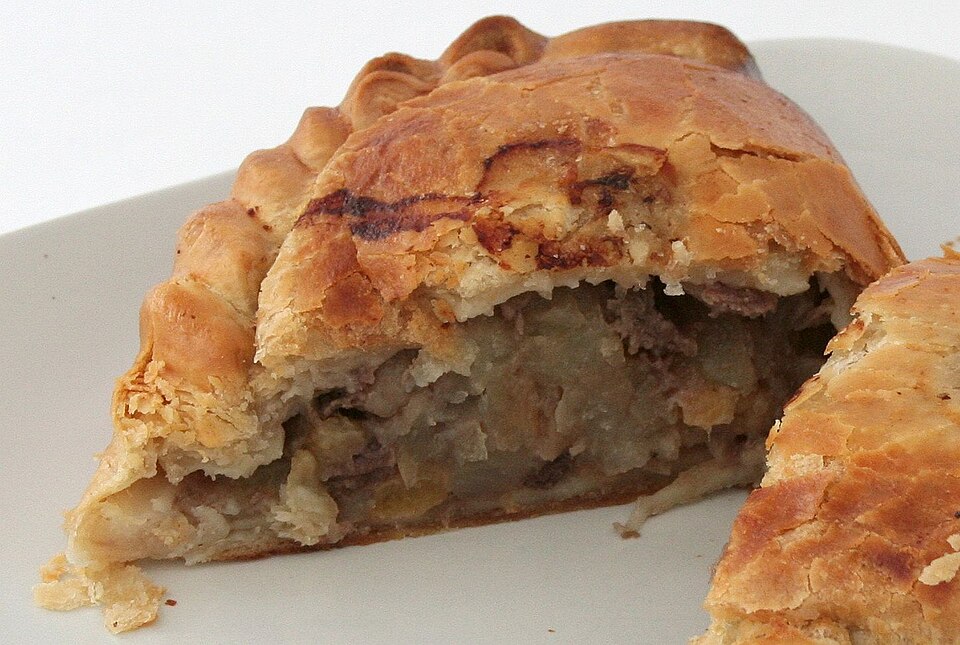
A pasty (Cornish: pasti, hoggan, incorrectly written as pastie) is a type of pie, originally from Cornwall, in the United Kingdom. It is a baked savory pastry case traditionally filled with sliced meat and vegetables. The ingredients are uncooked before being placed in the unbaked pastry case. Pasties with traditional ingredients are specifically called Cornish pasties. Traditionally, pasties have a semicircular shape, achieved by folding a circular pastry sheet over the filling. The circular ed
- Prep
- 32 min
- Cook
- 1 hr 13 min
- Total
- 1 hr 45 min
- Servings
- As written in source
- Difficulty
- Advanced
Timings are approximate — worked out from the method, not measured in a test kitchen.
Ingredients
Quantities are retained as written by the source and do not scale automatically. Tap an ingredient to check it off as you go.
Cooking instructions
Procedure
Preheat oven to 400°F 200°C Gas Mark 6.
Procedure
Lightly dust the prepared meat in seasoned flour (optional but makes a thicker gravy of the enclosed juices).
Procedure
Divide the pastry into 4 equal portions. Roll each into circles.
Procedure
Layer meat and vegetables on one half of each pastry circle to within 1 inch of the edge. Season generously.
Procedure
Brush milk onto the edge of the pastry circles (optional).
Procedure
Bring the other half of the dough over the top of the mixture.
Procedure
Pinch and twist to seal the dough around the edges.
Procedure
Make a couple of small slashes in the top of the pastry to allow steam to escape.
Procedure
Brush pasties with the remaining milk (optional).
Procedure
Use pastry trimmings to make the intended eater's initial(s) on one end of the pasty. This is the Cornish housewife's traditional way of making and identifying individual pasties to suit each family member e.g. less seasoning for young children or more meat for a hard-working son or anaemic daughter. Also, it enabled tin-miners and fishermen to identify their pasties if they had had to put them down somewhere half-eaten to attend to some urgent work.
Procedure
Place the pasties on a lightly-greased baking tray (or a double thickness of aluminium foil directly onto the oven shelf).
Procedure
Bake for about 45 minutes on the middle shelf of the preheated oven.
Procedure
Best taken with a pint of bitter or stout or a large mug of strong tea.
Tips, notes, and variations
Try adding sweet-corn or different types of beans.
Tips, notes, and variations
To rewarm, place on a cookie sheet in the oven and make a tent with foil over them so only the inside is heated, and not the pie crust. By a campfire, just lay on a hot rock or on a plate tilted towards the fire; before long they are warm and ready to eat.
Tips, notes, and variations
Use a pie crust that doesn't crumble too easily, or the whole thing will fall apart.
Tips, notes, and variations
Apple variant: Add peeled and thinly sliced apples sprinkled with soft brown sugar.
Tips, notes, and variations
Broccoli variant: Parboil, drain, and salt the broccoli. Fill pastries well with the broccoli. A little cheddar cheese is good in this, instead of salt.
Tips, notes, and variations
Chicken variant: Add diced breast and leg meat, and continue as above.
Tips, notes, and variations
Date variant: Chop some stoned dates, and fill well.
Tips, notes, and variations
Eggy variant: Add diced green or smoked bacon (back is best), fresh parsley, and 1–2 eggs, according to size of pasty. Top-crimp from each end, and funnel beaten egg in before closing.
Tips, notes, and variations
Pork variant: Add pork, potatoes, onion, a pinch of salt, and fresh sage or thyme.
Tips, notes, and variations
Sorrel variant: Scald sorrel leaves, fill pasty, and serve with sugar and cream.
Tips, notes, and variations
Jam variant: Any kind of jam can be used. Make the pasties smaller than normal, otherwise a lot of jam is needed!
Tips, notes, and variations
Mackerel variant: Allow 1 or 2 mackerels for each pasty, cleaned and boiled as normal. Skin and bone them, lay on pasty, fill with fresh parsley, lightly season and close. Herring are good as well.
Tips, notes, and variations
Windy variant: A method of using the pastry remnants. Just make an empty pasty, but omit the steam slit, split open while still hot and fill with jam, cheese and chutney, or whatever takes your fancy!
Photo: David Johnson [1] · CC BY-SA 3.0 · http://creativecommons.org/licenses/by-sa/3.0/ · Photo source and licence
Wikibooks contributors · CC BY-SA 4.0 · https://creativecommons.org/licenses/by-sa/4.0/ · Adapted; quantities retained as written. · Original source
Read it through first
Skim all 26 steps before you start — it is the difference between cooking and firefighting.
Scale it
Use the quantities listed in the original recipe. Adjust them manually if making a different batch size.
Storage
Cool completely, then keep in an airtight container in the fridge for up to three days.
Reheating
Reheat gently with a splash of water in a covered pan, rather than blasting it, so nothing dries out.
Approximate values per serving. Worked out from the ingredient list — treat them as a guide, not a measurement.
Reviews
No reviews yet. If you cook this, come back and tell everyone how it went.