Onigiri
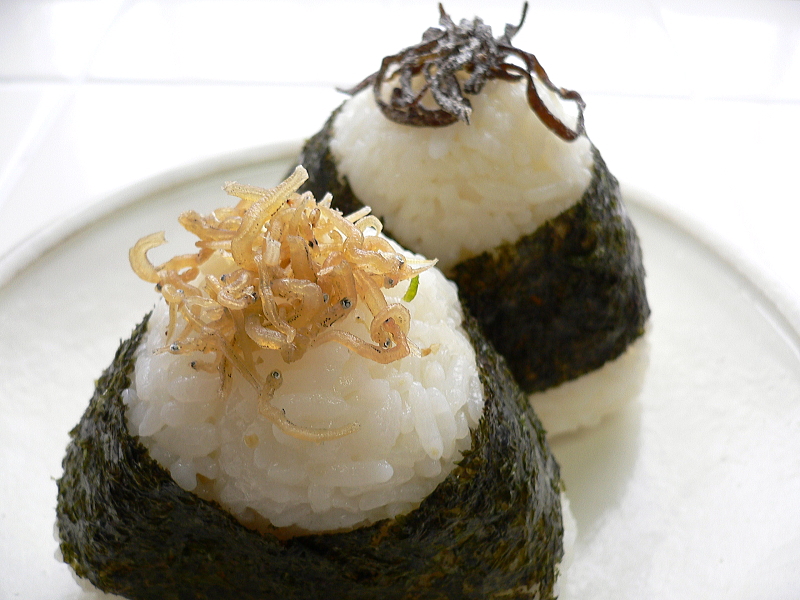
Onigiri (also called omusubi) is a ball or triangle of hot or cold rice, often with a filling, frequently wrapped in nori making it easier to eat. It is a popular snack food, and is also common as part of a packed lunch. Depending on your location, some convenience store chains have shelves with a large selection of fresh onigiri for sale.
- Prep
- 9 min
- Cook
- 1 hr 8 min
- Total
- 1 hr 17 min
- Servings
- As written in source
- Difficulty
- Medium
Timings are approximate — worked out from the method, not measured in a test kitchen.
Ingredients
Quantities are retained as written by the source and do not scale automatically. Tap an ingredient to check it off as you go.
Cooking instructions
Procedure
Cook the rice according to package or rice cooker directions. Let cool just enough to handle with your hands.
Procedure
While the rice is cooking, prepare your fillings.
Procedure
Fill a bowl with salt water to rinse your fingers and season the onigiri. You can fill and shape the onigiri using two different methods: Method 1: Wet your hands in the salt water. Take two large spoonfuls of rice into one hand (carefully; the rice is hot), and gently squeeze and flatten it with the other. Make an indentation in the middle, and put some of the filling into the center. Be a little careful to get the filling only in the center and not all over the ball; that can make the rice less sticky, and stickiness is good. "Fold" the rice over the filling so it becomes covered. Squeeze gently, and mold it into a triangular shape by folding both your hands along the palms while keeping the fingers straight. Squeeze like that, rotating the ball a few times, and you will soon have a very neat triangle—this really is much harder to explain than to do. Once the ball is done, put it down on a clean surface to cool down. Rinse your hands in the salt water and repeat. Method 2: Use a bowl and some plastic film. Place about ⅔ of the mixture into the centre of the cling wrap that has been draped into the bowl loosely. Then, add approximately 2 teaspoons of filling (this is working off of about 3–4 portions per cup of rice. Then, place the last ⅓ of the rice to the top. Then, mould the onigiri within the cling wrap. This drastically reduces mess and also is slightly more 'kid friendly'.
Procedure
Once the balls are reasonably cool, you need to protect them from drying out. The easiest way is to wrap them in cling wrap, or put them into an airtight plastic food container. When it is time to eat, take one rice ball, wrap it in a piece of nori, and eat away. If you don't mind soggy nori, you can wrap the balls in nori beforehand.
Notes, tips, and variations
You must use Japanese-style short grain rice; if the rice isn't sticky, the onigiri won't hold together.
Notes, tips, and variations
A rice cooker is recommended since it will be far more 'hands-off' and will also free up more time to prepare the fillings.
Notes, tips, and variations
There is wide latitude on what you can use as a filling. Try experimenting!
Notes, tips, and variations
It is a good idea to have a moderately large, clear workspace that is easy to clean afterwards. The rice is sticky, and you will end up getting it everywhere in the area.
Notes, tips, and variations
Do not use refrigerated, cold rice. Do not refrigerate the onigiri after assembling. Store in lunch cooler or thermos—otherwise the rice gets hard and doesn’t taste good. You can freeze onigiri, then microwave them to defrost.
Notes, tips, and variations
Fillings for onigiri are only limited to your imagination. One point to remember is to choose fillings that are not overly hard/crunchy. If they are reasonably hard they become quite difficult to eat. Western fillings that can be quite delicious include such things as corned meats, avocado, even olives or semidried tomatoes. A recommendation is to use fillings with a lot of flavour and cut into small pieces.
Photo: yomi955 · CC BY 2.0 · https://creativecommons.org/licenses/by/2.0 · Photo source and licence
Wikibooks contributors · CC BY-SA 4.0 · https://creativecommons.org/licenses/by-sa/4.0/ · Adapted; quantities retained as written. · Original source
Read it through first
Skim all 10 steps before you start — it is the difference between cooking and firefighting.
Scale it
Use the quantities listed in the original recipe. Adjust them manually if making a different batch size.
Storage
Cool completely, then keep in an airtight container in the fridge for up to three days.
Reheating
Reheat gently with a splash of water in a covered pan, rather than blasting it, so nothing dries out.
Nutrition information is not available for this recipe yet.
Reviews
No reviews yet. If you cook this, come back and tell everyone how it went.