Idli (Steamed Rice and Black Gram Bread)
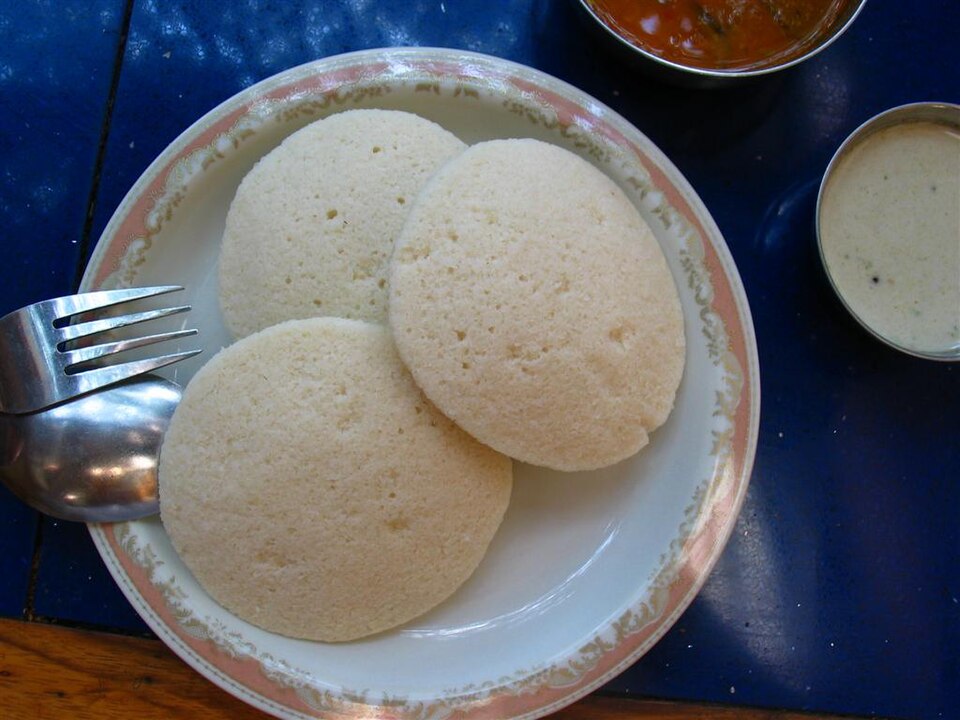
Idli is a round, fluffy bread roughly eight centimetres in diameter. It is made from ground rice or rice flour mixed with ground urad dal, salt, methi (fenugreek seeds) and water. The mixture is allowed to ferment prior to being steamed in an idli steamer. They are traditional to Southern India and are most often eaten with sambar.
- Prep
- 50 min
- Cook
- 1 hr 57 min
- Total
- 2 hr 47 min
- Servings
- As written in source
- Difficulty
- Advanced
Timings are approximate — worked out from the method, not measured in a test kitchen.
Ingredients
Quantities are retained as written by the source and do not scale automatically. Tap an ingredient to check it off as you go.
Cooking instructions
Procedure
Wash rice and urad dal thoroughly.
Procedure
Soak the rice and urad dal in separate bowls for no more than 2 hours. Soak methi seeds along with the urad dal. You will need about twice as much water in the bowl as urad dal, as it expands as it soaks up water.
Procedure
Drain the rice and urad dal. Do not discard the dal soaking water, but do discard the rice soaking water.
Procedure
Grind the urad dal to a fine paste in a blender. If needed, add some of the reserved soaking water.
Procedure
Grind the rice to a paste with about 1 cup of chlorine-free water (less if you can). Grind coarsely if the batter will only be used for idli, but grind finely if it will later be used for dosa.
Procedure
Mix the rice and urad dal pastes together well, and season with salt.
Procedure
If desired, stir in the fermentation starter and mix well (see note).
Procedure
Set aside somewhere warm like to ferment for 8 hours (see note).
Procedure
Grease one or more idli pans well with ghee or vegetable oil.
Procedure
Gently spoon the batter into the round indentations of the idli pans. Do not stir or otherwise break the batter. The trapped bubbles should not escape as they are necessary for a fluffy texture.
Procedure
Steam for 12 minutes in a steamer (16 minutes if using brown rice).
Procedure
Remove idli from pans with a sharp knife or thin spatula.
Notes, tips, and variations
A traditional stone grinder is recommended for making idlis. A blender will do a reasonable job; do not use a food processor.
Notes, tips, and variations
Idli is made of black lentil and rice. The southern parts of India use boiled rice, while the rest uses raw rice. It depends on your taste. The black lentil should be the full, round variety. Avoid broken dal.
Notes, tips, and variations
The ratio of black lentil to rice should not exceed 1:3 or 1:4 by volume. If you have good quality dal, you can stretch this ratio by increasing the quantity of rice.
Notes, tips, and variations
The rice is typically parboiled short grain white rice, but brown rice works well also and adds flavour, colour, and more nutrition. Brown rice needs to be soaked at least 4–6 hours.
Notes, tips, and variations
Mix the dal and rice batters thoroughly. It takes more time and energy than you might think. Uneven mixing causes many failures. Mixing them by hand works best!
Notes, tips, and variations
A warm temperature is essential for fermentation. 25–28 °C (77–82.4 °F) will be ideal. If the weather is cold, keep some warm water in a large bowl and immerse the vessel containing the batter. To help maintain the temperature of the warm water bath, cover it with a blanket, or better, use a regulated heater, like a heating pad or aquarium heater. Even easier, turn on the light in the oven, and use that to keep the batter warm.
Notes, tips, and variations
Allow at least 8 hours to ferment. If you don't see tiny bubbles the next morning, the dough will not rise and you have to start all over again.
Notes, tips, and variations
If you can't get the batter to ferment by itself, try adding a fermentation starter like a spoonful of commercially prepared idli batter (commercial idli batters sold under refrigeration may have live culture), or a teaspoonful of yogurt with live cultures. Kefir may be used, but yogurt is best. Plain bread yeast will not make for good flavour, as bacteria are needed also.
Notes, tips, and variations
Use chlorine-free water or reverse osmosis water. Tap water will work, but it will inhibit the fermentation a little. Most modern water filters remove both chlorine and chloramine.
Notes, tips, and variations
Sprinkle the idlis liberally with sesame oil and eat them with suitable side dishes, such as chutni, sambaar and idli powder.
Notes, tips, and variations
Leftover batter that has lost its froth can still be used to make dosa.
Notes, tips, and variations
Some Indian groceries may stock fresh ready-to-cook idli batter in the refrigerated section. This produces a very good idli, light and fluffy with a characteristic tangy flavor. However, some of these products are fermented using citric acid and chemical leavening (i.e. baking powder) and may not be as beneficial.
Photo: Nick Gray · CC BY-SA 2.0 · https://creativecommons.org/licenses/by-sa/2.0 · Photo source and licence
Wikibooks contributors · CC BY-SA 4.0 · https://creativecommons.org/licenses/by-sa/4.0/ · Adapted; quantities retained as written. · Original source
Read it through first
Skim all 24 steps before you start — it is the difference between cooking and firefighting.
Scale it
Use the quantities listed in the original recipe. Adjust them manually if making a different batch size.
Storage
Cool completely, then keep in an airtight container in the fridge for up to three days.
Reheating
Reheat gently with a splash of water in a covered pan, rather than blasting it, so nothing dries out.
Nutrition information is not available for this recipe yet.
Reviews
No reviews yet. If you cook this, come back and tell everyone how it went.