Gravlax
Gravlax is salmon that is cured in salt and sugar. It is a common dish throughout Scandinavia. Gravlax is easy to make and makes a festive dish that is an excellent to serve at parties with many people. The process of curing fish in salt and sugar (grava) is not limited to salmon and works fine with any fatty fish although salmon is definitely the most common choice. Gravlax has been particularly popular and common in the northern regions of Scandinavia whose cold and fresh waters produce salmon
- Prep
- 47 min
- Cook
- 1 hr 51 min
- Total
- 2 hr 38 min
- Servings
- As written in source
- Difficulty
- Advanced
Timings are approximate — worked out from the method, not measured in a test kitchen.
Ingredients
Quantities are retained as written by the source and do not scale automatically. Tap an ingredient to check it off as you go.
Cooking instructions
Procedure
Cut the salmon filet into two equally-sized parts (if you are making gravlax for many people it is fine to use two filets instead). Freeze the salmon for at least 4 days at -18°C or colder to kill any parasites.
Procedure
After deep freezing the salmon remove it from the freezer and let it thaw, preferably overnight in the refrigerator. The salmon does not have to be completely thawed for the next steps.
Procedure
Combine the salt and sugar. Place the salmon, skin down, on a table. Rub the salt and sugar mix onto the pieces, then apply the juniper berries and pepper. Finally, cover with dill.
Procedure
Put one salmon piece on top of another, flesh side to flesh side so the skin it outside on both pieces, and place in a plastic bag. Add any leftover ingredients to the bag along with the gin.
Procedure
Seal the bag and place it in the refrigerator. Let the salmon cure in the mixture, turning the bag over once, preferably twice, a day for 4 days.
Procedure
After 4 days, the salmon is ready to serve. If you are not going to eat it immediately (it lasts a couple of days) move it to a fresh plastic bag or jar, removing the salty liquid that has formed in the original bag. If you keep it in the original bag the risk is that it may be too salty once you are about to serve it.
Procedure
Use a sharp knife to slice thin slices from the salmon at an angle. During slicing, also remove any remaining bones. The larger the piece of salmon the larger the angle and the larger surface area for the produced slices. Large slices look better when served.
Procedure
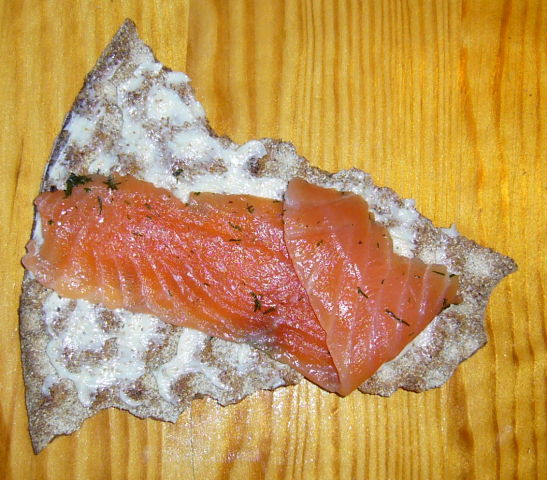
As a main dish, serve with potato stew, boiled potatoes and gravlax sauce, or in a salad. As an appetizer, serve on crispbread or toast. Potato stew with some additional Dijon mustard is excellent addition to gravlax.
Procedure
Steps
Procedure
Thawed salmon with the required ingredients.
Procedure
Apply salt and sugar.
Procedure
Apply pepper and juniper berries.
Procedure
Cover with dill.
Procedure
Place one piece on top of the other.
Procedure
Seal the salmon in a plastic bag and refrigerate.
Procedure
Serve thin slices of the cured salmon.
Notes, tips, and variations
Use the thick part of the salmon filet found towards the head. Don't use the part closest to the tail, since it is not thick enough.
Notes, tips, and variations
The gin can be substituted by lemon or lime juice (like a ceviche).
Notes, tips, and variations
The time can be greatly shortened by slicing the salmon thinly before curing it. It can be ready with as little as 4 hours of curing time. However, using this method means it should also be eaten sooner.
Photo: Aarno at English Wikibooks · CC BY-SA 3.0 · https://creativecommons.org/licenses/by-sa/3.0 · Photo source and licence
Wikibooks contributors · CC BY-SA 4.0 · https://creativecommons.org/licenses/by-sa/4.0/ · Adapted; quantities retained as written. · Original source
Read it through first
Skim all 19 steps before you start — it is the difference between cooking and firefighting.
Scale it
Use the quantities listed in the original recipe. Adjust them manually if making a different batch size.
Storage
Cool completely, then keep in an airtight container in the fridge for up to three days.
Reheating
Reheat gently with a splash of water in a covered pan, rather than blasting it, so nothing dries out.
Approximate values per serving. Worked out from the ingredient list — treat them as a guide, not a measurement.
Reviews
No reviews yet. If you cook this, come back and tell everyone how it went.