Basic Indian Tomato Gravy
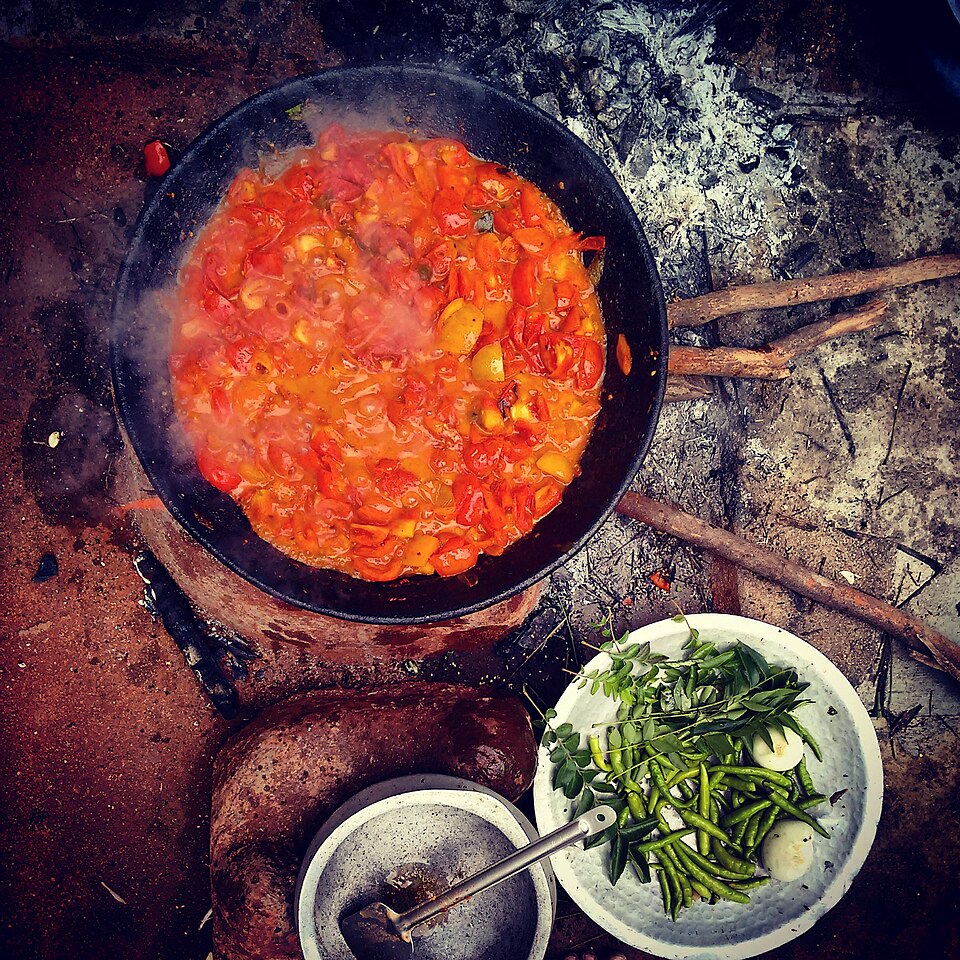
This traditional Indian tomato gravy can be used as a base for all sorts of vegetables, boiled eggs, cubed paneer or chicken. This is often referred to as a "curry". It is usually eaten with plain white rice or rice mixtures.
- Prep
- 22 min
- Cook
- 52 min
- Total
- 1 hr 14 min
- Servings
- As written in source
- Difficulty
- Advanced
Timings are approximate — worked out from the method, not measured in a test kitchen.
Ingredients
Quantities are retained as written by the source and do not scale automatically. Tap an ingredient to check it off as you go.
Cooking instructions
Procedure
Fry the onions in hot ghee until they start to brown.
Procedure
Add the ginger and garlic and stir, then add the powdered spices. Blend well.
Procedure
Throw in the tomatoes and salt to taste.
Procedure
Turn the flame down to medium and cover for ten minutes. This will form a spicy gravy to which you can add any mixture of vegetables or boiled eggs or fried fish or chicken or lamb/goat.
Notes, tips, and variations
If adding cooked vegetables, keep the pot on the flame until they are uniformly heated; for uncooked vegetables, cook as long as necessary.
Notes, tips, and variations
With chicken/lamb/goat, add the marinated poultry/meat after frying the ginger garlic paste and adding the dry spice powders. Sear the poultry/meat on high heat, turning the pieces continuously for about 10–15 minutes until the juices get sealed inside. Add the tomatoes after this step. Continue cooking as per above recipe. Alternatively, you have the option of frying /roasting/grilling the marinated poultry/meat separately, before adding to the curry, then letting it simmer for at least 20 minutes.
Notes, tips, and variations
You can add a little cayenne and cumin and leave out the chili powder (though "chili powder" in Indian recipes is cayenne/powdered chilis)
Notes, tips, and variations
Depending on the freshness of your spices, you may want to add extra spices in the same ratio to achieve a stronger flavour.
Notes, tips, and variations
Generally, in Indian cuisine, for lamb or goat (known locally as 'mutton'), you can use all the above ingredients to make the gravy (curry). Some recipes use curd/yogurt, while some use tomatoes for the balancing tart flavour. With chicken, lamb and goat, marination is preferred. Also, various spice powders and spices (sabut garam masala) are added depending on the recipe. For example, cloves and cinnamon can be added to the hot oil, to give an excellent flavour.
Notes, tips, and variations
For a vegan version of this recipe, substitute the ghee with coconut oil or other vegetable oil.
Notes, tips, and variations
You can also use a pressure cooker instead of the stovetop; in this case, cook it for 6−7 whistles on a medium flame. This is especially useful when cooking lamb or goat as the meat is tougher than chicken.
Notes, tips, and variations
You can also use fried onions as garnish to get a gravy with a different flavor. This is used frequently in chicken recipes.
Photo: Shashimangu · CC BY-SA 4.0 · https://creativecommons.org/licenses/by-sa/4.0 · Photo source and licence
Wikibooks contributors · CC BY-SA 4.0 · https://creativecommons.org/licenses/by-sa/4.0/ · Adapted; quantities retained as written. · Original source
Read it through first
Skim all 12 steps before you start — it is the difference between cooking and firefighting.
Scale it
Use the quantities listed in the original recipe. Adjust them manually if making a different batch size.
Storage
Cool completely, then keep in an airtight container in the fridge for up to three days.
Reheating
Reheat gently with a splash of water in a covered pan, rather than blasting it, so nothing dries out.
Approximate values per serving. Worked out from the ingredient list — treat them as a guide, not a measurement.
Reviews
No reviews yet. If you cook this, come back and tell everyone how it went.